


There is a peculiar doubling in how we remember Suleiman I. In the West, he is "the Magnificent" — a title given not by his own court, but by Venetian and Habsburg ambassadors. At home, he was the Kanuni, the Lawgiver. The gap between these two epithets contains the whole of his reign.
The Architecture of Reputation
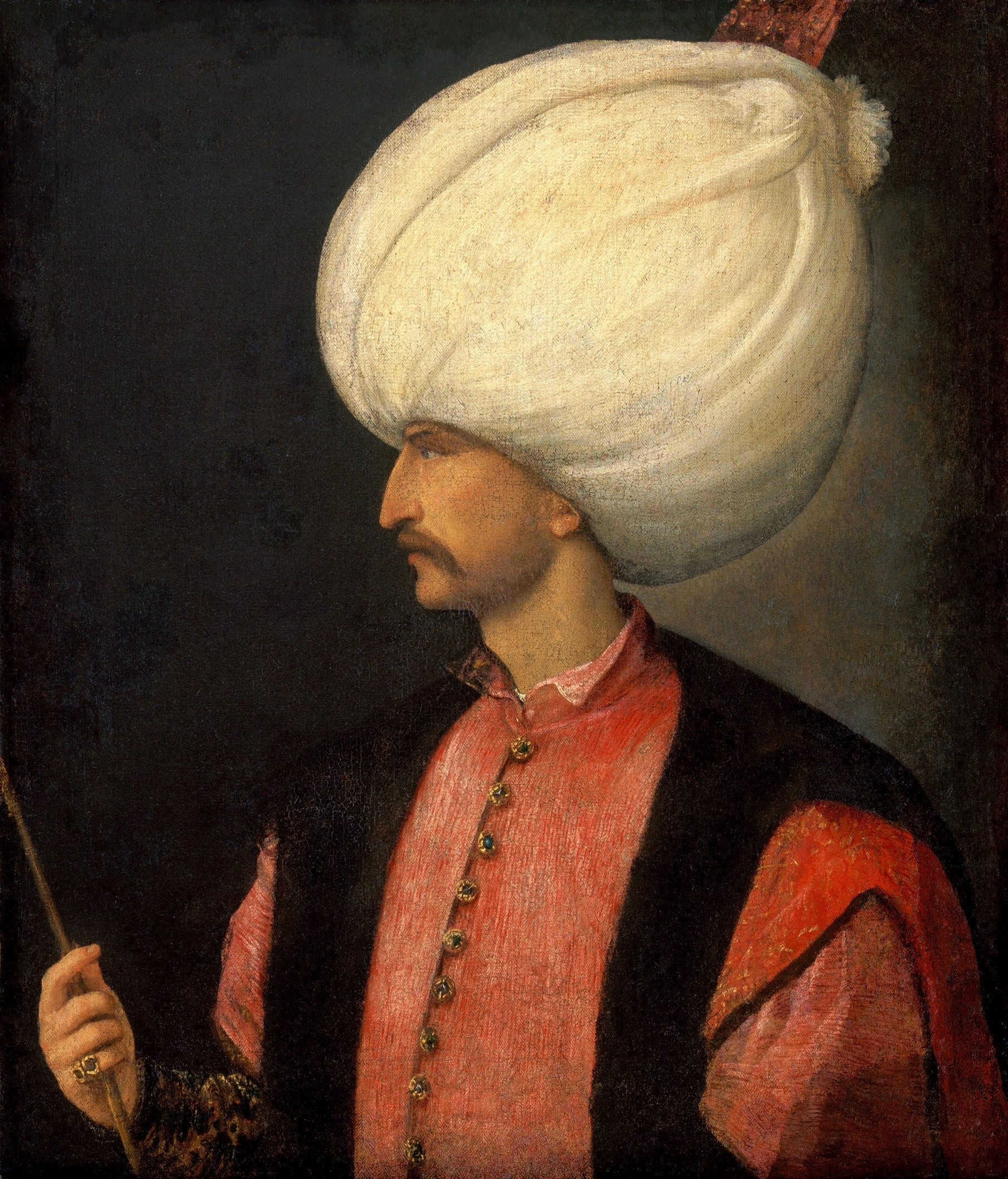
Suleiman understood that reputation was not merely the residue of action — it was itself a policy instrument. Court ritual, architecture, and diplomatic staging worked in concert to produce authority before a decree was read.
The gap between "the Magnificent" and "the Lawgiver" is the gap between being seen and being known.
The Lawgiver's Paradox
The Kanuni epithet captures a claim to sovereignty grounded not only in conquest but in order, legitimacy, and world-historical inheritance — aligning Suleiman with Solomon, whose very name his echoed.
Conquest and Controlled Glory
Suleiman's reign undoubtedly earned its reputation through military achievement. Belgrade fell in 1521. Rhodes followed in 1522 after a gruelling siege that expelled the Knights Hospitaller from their island stronghold. At the Battle of Mohács in 1526, the Kingdom of Hungary collapsed in little more than two hours, fundamentally reshaping Central European politics.
To European observers, these victories seemed almost unstoppable. Reports arriving in Venice and Vienna described an empire with seemingly infinite manpower and inexhaustible resources. The failed siege of Vienna in 1529 did little to diminish this perception. Although the city held, Suleiman remained Europe's greatest strategic concern for decades afterwards.
Yet Ottoman chroniclers rarely celebrated conquest for conquest's sake. Instead, campaigns were presented as evidence that God favoured just rule. Victory became proof of legitimacy rather than its source. This subtle distinction helped preserve Suleiman's reputation even when campaigns produced mixed military outcomes later in his reign.
History often remembers successful generals because they won battles. Suleiman ensured his victories became chapters in a broader story about divine order, imperial justice and universal kingship.
The Golden Age of Ottoman Culture
If armies expanded the empire's borders, artists expanded its imagination.
Suleiman's reign witnessed an extraordinary flourishing of literature, miniature painting, ceramics, calligraphy and architecture. Iznik workshops produced brilliantly coloured tiles that decorated imperial mosques across the empire. Court historians meticulously recorded campaigns while poets transformed political events into epic narratives worthy of Persian kings.
Suleiman himself participated in this literary culture. Writing under the pen name Muhibbi ("The Lover"), he composed hundreds of poems in Ottoman Turkish and Persian. One of his best-known verses reads:
"The people think of wealth and power as the greatest fate,
But in this world a spell of health is the best state."
The authenticity of his authorship is widely accepted, and the poetry reveals an image carefully cultivated by the court: the warrior-scholar whose intellectual refinement matched his military success.
This cultural patronage further distinguished Suleiman from many European monarchs of his age. His empire became not merely a military superpower but one of the intellectual and artistic centres of the sixteenth-century world.
The Women Behind the Throne
No discussion of Suleiman's legend can ignore Hürrem Sultan, known in Europe as Roxelana. Captured as a slave before entering the imperial harem, she became Suleiman's legal wife—an extraordinary break from Ottoman dynastic convention.
European observers struggled to understand her influence. Rumours portrayed her as manipulative, ambitious and dangerously powerful. Ottoman sources, while more restrained, nevertheless reveal a woman deeply involved in charitable foundations, diplomacy and palace politics.
Their relationship became part of Suleiman's public image. Love poetry traditionally reserved for anonymous beloveds increasingly reflected personal devotion. Their marriage complicated the image of the distant, untouchable emperor and instead suggested a ruler capable of profound personal loyalty.
Whether romantic or strategic, their partnership altered Ottoman politics and contributed to the mythology surrounding Suleiman's reign.
The Limits of Magnificence
Despite the grandeur, Suleiman's reign was not without contradiction. The execution of his close friend and Grand Vizier Ibrahim Pasha shocked contemporaries. Later, the execution of his son Mustafa generated rumours that palace intrigue had overtaken imperial justice. These events exposed the tension between the image of the perfect lawgiver and the realities of dynastic politics.
Nor was the empire uniformly prosperous. Maintaining enormous armies, monumental building projects and an expanding bureaucracy placed increasing strain on imperial finances. Inflation driven partly by the influx of New World silver affected markets across Europe and the Mediterranean alike, including the Ottoman economy.
Yet remarkably, these difficulties scarcely diminished Suleiman's reputation. The myth had become strong enough to outlive the facts. Subsequent generations remembered the reign less for its internal crises than for its apparent perfection.
Inventing the Golden Age
Perhaps Suleiman's greatest achievement was convincing later generations that they lived after history's high point. Ottoman writers of the seventeenth century frequently looked back upon his reign as a lost golden age against which contemporary rulers inevitably fell short.
This retrospective idealisation became self-reinforcing. Historians, poets and administrators continued invoking Suleiman whenever discussing justice, competent governance or imperial greatness. Even periods of reform centuries later referenced his legal order as an ideal to recover rather than replace.
European historians developed a parallel myth. Renaissance travellers admired Ottoman discipline while Enlightenment thinkers often contrasted Suleiman's orderly administration with stereotypes of Oriental despotism. Although these interpretations differed dramatically, both reinforced the same conclusion: Suleiman represented an exceptional ruler whose reign marked an historical summit.
Why the Legend Endures
Five centuries after his death outside the fortress of Szigetvár in 1566, Suleiman remains one of the few pre-modern rulers instantly recognisable across cultures. Television dramas, museum exhibitions and popular histories continue to revisit his life because his story combines military conquest, political intrigue, romance, architecture and statecraft in unusual measure.
But perhaps the durability of his reputation owes less to what he accomplished than to how effectively those accomplishments were presented. Suleiman ruled during an age when imperial image-making became as important as imperial expansion. Through architecture, law, literature, diplomacy and ritual, his court created a coherent narrative of just, universal kingship that outlived the empire itself.
The title Kanuni was therefore never simply an honorific. It was a political argument. It asserted that true sovereignty rested not merely on armies or wealth but on the ability to create order from diversity and legitimacy from power.
That is why history remembers two Suleimans simultaneously. The West recalls the magnificent emperor dazzling ambassadors with splendour. The Ottoman world remembers the lawgiver who sought to embody justice. Neither image is entirely complete on its own. Together, however, they reveal something more enduring: a ruler who understood that power survives longest when it becomes a story people continue telling long after the empire itself has disappeared.